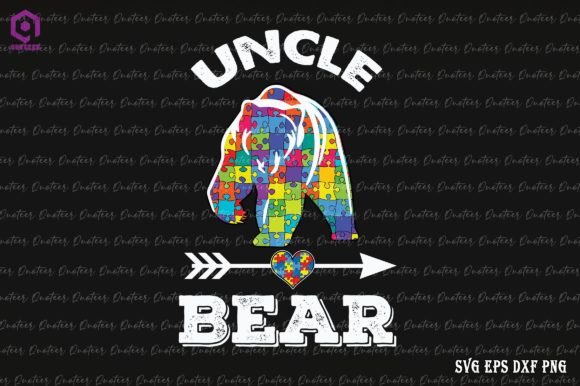
Uncle Bear Puzzle Piece Autism Family Graphics
As a brand designer who’s helped over 80 local businesses—from neighborhood bakeries to handmade soap studios—build cohesive, shelf-ready identities, I recently evaluated Uncle Bear Puzzle Piece Autism Family for a real-world project: a small-batch children’s sensory toy shop launching an inclusive holiday gift line. My goal wasn’t just to assess aesthetics—it was to determine whether this graphic design asset could function as reliable, versatile, and emotionally resonant infrastructure across packaging, labels, social media, and in-store visuals.
A Warm, Thoughtful First Impression—Not Just Cute
Opening the file set, the first thing that stands out is its intentional warmth—not saccharine or overly literal, but grounded in gentle expressiveness. The bear’s posture, the soft curvature of the puzzle piece integration, and the subtle textural hints in the vector lines suggest empathy, care, and quiet strength. It reads as handmade business friendly: approachable enough for a boutique children’s bookstore, refined enough for a pediatric therapy practice’s thank-you cards, and distinctive enough to avoid visual fatigue on crowded shelves. It leans into “soft modern”—not rustic, not ultra-minimalist, not festive-by-default—but carries emotional clarity that builds trust fast.
Where This Asset Earns Its Place in Real Local Business Branding
Uncle Bear Puzzle Piece Autism Family shines where authenticity and human connection matter most. For our toy shop client, we used it across six high-impact touchpoints:
- Product labels: Applied as a subtle corner accent on kraft paper swing tags—no competing with ingredient lists or safety icons, just a quiet signal of values.
- Packaging design: Scaled down for die-cut sticker seals on recycled gift boxes; the SVG held crisp detail at 1.5” width.
- Social media graphics: Layered over neutral-toned flat-lays in Canva (using the PNG with transparency) for Instagram Stories promoting neurodiversity awareness month.
- Printable design elements: Embedded in downloadable activity sheets for families—leveraging the EPS for clean CMYK output on home printers.
- Business cards & thank-you cards: Used as a monochrome foil stamp on matte cardstock—proof that the vector retains elegance even without color.
- Seasonal campaign visuals: Paired with hand-lettered type in a limited-edition holiday banner, reinforcing brand identity without overwhelming the message.
Why It Strengthens Small Business Presentation—Beyond Decoration
This isn’t clipart you drop in and forget. When integrated intentionally, Uncle Bear Puzzle Piece Autism Family delivers measurable branding lift: it sharpens visual hierarchy by anchoring emotional context before text; supports consistent brand identity across digital and physical touchpoints; and—critically—signals alignment with community values, deepening customer trust in a way stock illustrations rarely do. On shelf, it boosts product recognition through distinctive silhouette and tone. In print, its vector foundation ensures professional branding at any scale—no pixelation on a 4” candle label or 24” window decal.
Best Fit: Contexts That Let It Breathe
It works strongest when given breathing room and purpose. Ideal applications include:
- Hero graphics for inclusive product launches (e.g., sensory-friendly snack boxes)
- Decorative brand elements on reusable tote bags or tea towels
- Accents on hang tags for handmade business merchandise
- Stickers for thank-you cards or loyalty programs
- Boutique visuals—especially for children’s wear, home goods, or wellness brands centered on care
- Social media campaign graphics tied to awareness, education, or community storytelling
Use With Intention—Not Everywhere
This asset isn’t universal. Avoid forcing it into contexts where clarity, formality, or restraint is non-negotiable: legal disclaimers, ingredient-heavy food labels, luxury minimalist skincare branding, or dense regulatory packaging. It can compete visually if placed beside busy patterns or low-contrast backgrounds (test against your actual label stock!). And while charming, it’s not suited for corporate annual reports or formal medical branding—its voice is personal, not institutional.
Practical Designer Notes You’ll Actually Use
Before committing to Uncle Bear Puzzle Piece Autism Family in client work or your own product mockup, run these checks:
- Test the SVG in your vector editor—confirm paths are clean, layers are named, and anchor points allow subtle tweaks (e.g., adjusting bear ear angle to match your brand’s playfulness level).
- Preview the PNG on real packaging: does transparency render cleanly over kraft, white, or pastel substrates?
- Print a 0.75” version on your intended label material—does it retain legibility and warmth?
- Pair it with your brand fonts: try it beside a sturdy sans serif (for clarity), a delicate script (for warmth), and a bold display font (for contrast)—see where hierarchy holds.
- Check black-and-white usage: does the shape remain expressive without color cues? (It does—this one passes.)
- Verify commercial license terms—especially if applying to physical products for resale. This is a commercial design asset, but always cross-check permitted use cases.
- Compare against competitor packaging: does it stand out meaningfully without feeling isolated or tonally mismatched?
For local business owners building something real—whether it’s lavender-scented soy candles, small-batch granola, or handmade wooden puzzles—Uncle Bear Puzzle Piece Autism Family isn’t just another download from a creative marketplace. It’s a thoughtful, technically sound graphic design asset that, when applied with intention, elevates small business branding from functional to felt. It supports packaging design that communicates care before a word is read—and in today’s market, that kind of resonance isn’t decorative. It’s essential.